







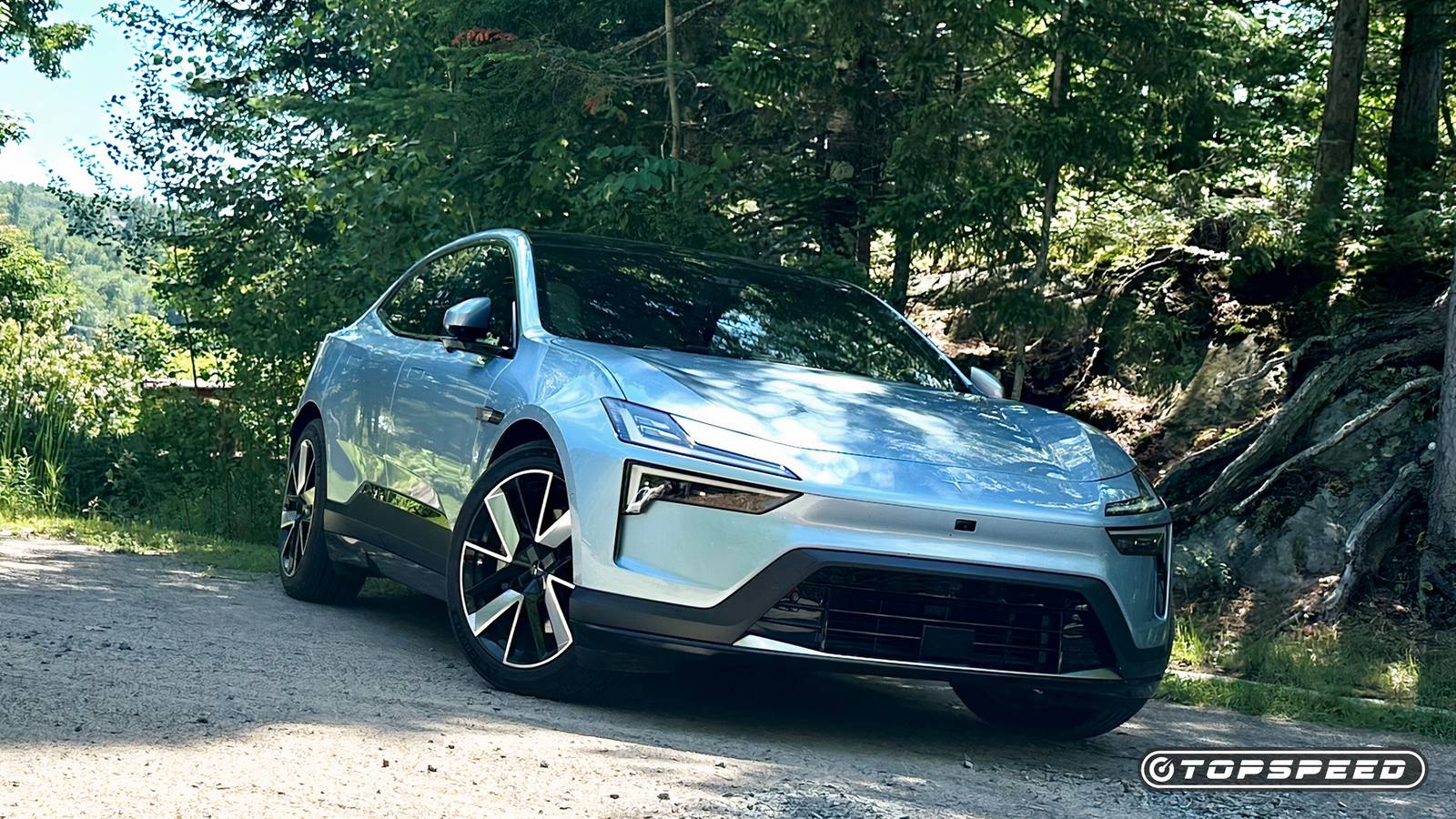
The 2026 Polestar 4 is an all-electric SUV coupe that blends sleek, futuristic design with innovative technology, aiming to stand out in the compact luxury EV market. Unlike the boxier Polestar 3 SUV, the 4 features a coupe-like silhouette with a sloped rear and no rear window, prioritizing style and efficiency.
A spinoff of the Volvo brand, Polestar is still trying to make a name for itself in an increasingly competitive market. I drove the Polestar 4 for a day in Montreal, Canada, testing its performance, comfort, and technology in both city and highway conditions. This review covers the dual motor, priced at approximately $62,900.
2026 Polestar 4 First Impressions
Upon first seeing the Polestar 4, I was struck by its design, which blends the sporty lines of a coupe with the practicality of an SUV. The absence of a rear window creates a distinctive, uninterrupted rear profile, and is something you don’t really notice until you truly take a good look at the back of the vehicle.
Exterior Dimensions
|
Length |
190.5 inches |
|
Width |
81.4 inches |
|
Height |
60.4 inches |
|
Wheelbase |
118.0 inches |
|
Front Track |
67.0 inches |
|
Rear Track |
67.6 inches |
|
Curb Weight Single Motor |
4,196 pounds |
|
Curb Weight Dual Motor |
5,192 pounds |
The design is almost understated, with smooth lines and plenty of curves. It draws your attention for its simplicity, not for trying too hard to look like an EV. Although that was once a design trend, today’s EVs increasingly ditch the gimmicky design elements that early EVs favored. That’s not a complaint. The Polestar 4 is a stylish, attractive vehicle that fits the brand’s aesthetic perfectly.
Driving Impressions And Performance
I drove the Polestar 4 on city streets, highways, and rural roads in and around Montreal. It was a diverse range of driving scenarios, and the Polestar 4 proved its mettle. It has more than enough power for easy highway merges. A heavy foot on the accelerator presses you back in your seat and plasters a smile on your face.
As fun as it is to experience the instant torque of an EV, the Polestar 4 proved even more fun on winding country roads. It delivered precise steering that made it easy to manage even though it’s not a sports car. Rough road surfaces were nicely muted, as were potholes and breaks in the pavement. It’s a well-mannered ride whether you’re navigating congested city streets or simply cruising down the highway.
Braking And Acceleration
Acceleration is strong with ample power for getting up to highway speeds and merging with high-speed traffic. A heavy foot on the accelerator yields instant results and, if anything, it’ll take you a little time to get used to easing up. EV acceleration is no joke, and it’s incredibly fun, but there is an adjustment period. Once you get used to the responsiveness of the Polestar 4, it becomes intuitive.
Performance Specifications
|
Single Motor (RWD) |
Dual Motor (AWD) |
|
|
Transmission |
Single-speed automatic |
Single-speed automatic |
|
Horsepower |
272 HP |
544 HP |
|
Torque |
253 LB-FT |
506 LB-FT |
|
Motor |
200 kW motor |
200 kW motors |
|
Battery |
100 kWh |
100 kWh |
|
Range |
310 Miles |
280 Miles |
|
Level 2 Charging (10–80 percent) |
30 Minutes |
30 Minutes |
|
0-60 MPH |
6.9 Seconds |
3.7 Seconds |
|
Top Speed |
124 MPH |
124 MPH |
|
Max Towing |
2,000 Pounds |
3,500 Pounds |
A vehicle with such strong acceleration and power needs to have brakes ready to handle the job. The Polestar 4 provides steady, confident braking that’s not too touchy, which is something that can throw many a new EV driver. Braking too hard can be jarring in an EV, but thankfully, it’s a short learning curve. The brakes on the Polestar 4 let you confidently take advantage of the vehicle’s power, knowing it will stop surely when you need to slow it down.
2026 Polestar 4 Fuel Economy
The EPA rates the Polestar 4 Single Motor at 90 MPGe combined (93 MPGe city, 87 MPGe highway), while the Dual Motor achieves 86 MPGe combined (86 MPGe city, 80 MPGe highway). During my day of driving, those figures matched up with what we experienced throughout a range of city and highway driving. It was a warm summer’s day in Montreal, however, so it’s worth noting that those figures will drop during winter driving, when cold takes a toll on every EV battery’s performance.
|
City |
Highway |
Combined |
|
|
Single Motor |
93 MPGe |
87 MPGe |
90 MPGe |
|
Dual Motor |
86 MPGe |
80 MPGe |
83 MPGe |
Interior Design And Comfort
The Polestar 4’s interior is a standout, managing to be both minimalist and upscale, with a bright, airy feel. The panoramic glass roof, available with optional electrochromic film, floods the cabin with light, creating an open atmosphere even without a rear window. That lack of a rear window seems like it would make the cabin dark, but it’s something you don’t even notice, even sitting in the rear seats.
The driver’s seat was supportive but not overly firm, making it good for long drives or short treks around town. The rear seats were surprisingly spacious with generous legroom and headroom. No official interior measurements are available, but sitting inside the Polestar 4, it feels bigger than it looks. Soft-touch surfaces felt premium, with textures that add visual appeal. The 15.4-inch infotainment screen was easy to reach, but Polestar put too many controls in that screen. Notably, there are no manual vent controls. Adjusting the vents in the screen is cumbersome.
Storage was practical, with four cupholders, front seatback nets, and a rear armrest cubby. Rear-seat comfort for adults was excellent, though taller passengers might find headroom snug thanks to that sloped roof. Overall, the interior of the Polestar 4 balances eco-conscious design with premium comfort. It’s also quiet with a minimum of road and wind noise intruding into the cabin.
Technology And Ease Of Use
The Polestar 4’s technology suite is both advanced and user-friendly, centered around a 15.4-inch infotainment touchscreen with a Google-based interface. Graphics are crisp, and the screen is responsive with minimal lag. Connecting wireless Apple CarPlay was seamless, requiring only a quick Bluetooth pairing.
The 10.2-inch driver display provided clear readouts of speed, range, and battery status with a 14.7-inch head-up display. Special call out to Snow mode, which changes the display to a light yellow for better visibility on snowy backgrounds. The 8.9-inch digital rearview mirror is also a highlight, and a necessity, since there’s no rear window.
However, the infotainment-only vent controls were a significant drawback, requiring multiple taps to adjust airflow, which was distracting while driving. The optional Harman Kardon audio system delivers rich sound, enhancing the in-cabin experience. Adaptive cruise control and lane-centering features worked smoothly and, overall, the technology is a strong point, but the lack of tactile controls for basic functions detracts from its practicality.
Cargo And Storage Space
The Polestar 4 offers 18.6 cubic feet of cargo space with the rear seats up and 54.2 cubic feet with the 60/40 split seats folded, including under-floor storage. Loading is easy with an available power liftgate and an adjustable cargo floor that is nice and low, so it’s less difficult to load heavy items. Additional storage included a 0.5-cubic-foot frunk. There are also four cupholders, front seatback nets, and side net pockets.
|
Minimum Cargo Capacity |
18.0 Cubic-Feet |
|
Cargo Capacity Second-Row |
54.2 Cubic-Feet |
|
Frunk |
0.5 Cubic-Feet |
Our Recommendation For Which Model You Should Buy
Pricing for the single-motor rear-wheel drive Polestar 4 is $56,400, while the dual-motor all-wheel drive variant is $62,900. If you live where winter weather is a concern, then spring for the dual-motor. Otherwise, we’d stick with the single motor. It’s nearly $6,000 cheaper, and it comes with a longer range by 30 miles. Although most people won’t care about that extra range on a daily basis, the minute you venture out on a road trip or to someplace new, having the extra range makes a big difference. Charging time is still the same either way since there’s only one battery size, so what it comes down to is primarily comfort and convenience features. If that’s your priority, then step up to the dual motor trim, but we’d go with the base model and keep more of our cash in our wallet.
Read the full article here


