






Here’s what we know about Kia: They’re an incredibly style-forward carmaker. This is the brand that went from dull artistry and under-engineered copycats in the early 2000s to design-winning models across the board by 2020. In conversations with the carmakers’ designers at the New York Auto Show this year, I learned that Kia doesn’t confine its visible branding to cookie-cutter scaling up or down. That’s why the new Telluride can look brawnier than ever—even Range Rover-esque—while the EV6 looks like a robotic bullet slicing through the wind.
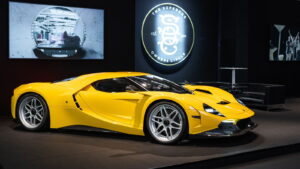
But we also know that Kia’s had to pivot—like all carmakers—in the face of rising tariffs and cooling demand for EVs. They’re chasing a just-right mix of hybrids now, which is why that next Telluride, like its twin, the Hyundai Palisade, will get a hybrid option. This Kia concept, only released on YouTube, foreshadows and perhaps embodies that pivot toward multiple powertrains and the rebirth of a short-lived icon, the Kia Stinger. How Kia achieves this, if in fact that’s what we’re staring at, is still TBD. But here’s a decent stab.
Let Scale Be Your Guide
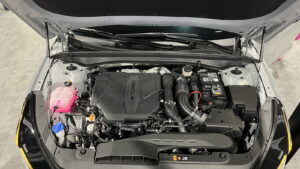
Kia’s about to debut a new Telluride that will get the same 2.5-liter turbocharged four paired to two electric motors that’s motivating the Hyundai Palisade Hybrid. That powertrain will crank out 329 horsepower. For reference, the 3.3-liter twin-turbocharged V-6 in the most potent Kia Stinger produced 365 horsepower and 376 foot-pounds of torque. However, the new hybrid in the Telluride is capable of just under 400 foot-pounds of torque.
In this close-up clipped from the YouTube reveal of the Kia Concept, you can see that the hood is quite short. If the concept represents any actual production intention, perhaps the more likely hybrid powertrain would be the 1.6-liter four out of the Sorento. That engine and electric-motor combo is good for up to 227 horsepower in the Sorento, but up to 231 horsepower in its Hyundai Santa Fe twin.
Why It Could Be A Sporty EV
One reason why not? Kia just killed the EV4 in this market. That doesn’t preclude its sale globally, but the other issue with the EV4 was that it was an odd fit for Americans. It’s not “crossover lite,” a la the EV6, which sits a little higher and features the utility of a hatchback. The stillborn EV4 for the U.S. was designed to have a trunk, which is a complete miss for the U.S. Just look at everything in the not-stupid-expensive EV realm, and all models here already or on the way, from Toyota’s small C-HR to the next Chevy Bolt to the Nissan Leaf that we just crowned with a Buzz Award, are hatchbacks.
The Stinger Reborn As An EV
And, speaking of that Toyota, it’s debuting with 335 horsepower, and we’re expecting it to be fast and sporty. If Kia wants to bring back the Stinger as a rival to the C-HR Toyota, it would make reasonable sense. However, it wouldn’t be any such thing if it’s meant to have the 201-horsepower output of the EV4 and that model’s front-wheel drive.
TopSpeed’s Take
There are two telltales of “DNA” visible during the above video. One shows the end-on view, where the rear fender and hatch echo, somewhat, the design of the new K4 hatch’s behind. Then there’s this clip, where you can see a triangular haunch bulging where the front door seam intersects the front fender. That triangle is mirrored at the rear fender arch.
Kia’s ethos is pretty much in league with most brands: Chunkier haunches broadcast prowess. So, I’m expecting that this will be either the successor to the EV6, probably first showing off a GT version, or that this is a hybridized Stinger. Or, even (perhaps very wisely), a Stinger sub-brand. Because with Toyota about to do the same thing with GR, overlapping Lexus with a supercar, Kia may debut a performance division of its own, perhaps repurposing Magma chassis elements from Genesis. Hey, that’s exactly how Stinger was born the first time around, so rinse, repeat, and bingo: New Stinger!
Read the full article here


