






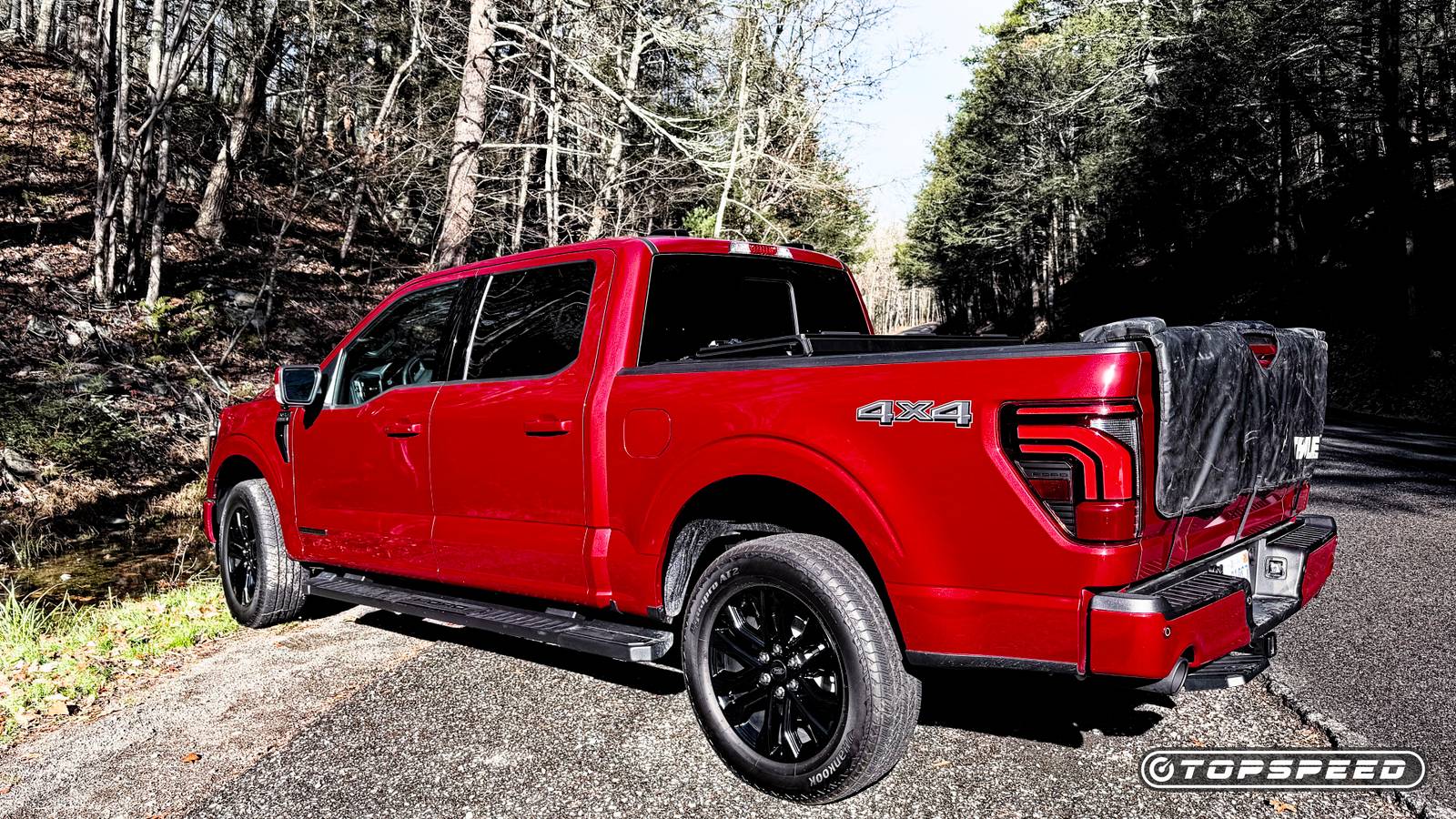
That picture is of Ford’s F-150 PowerBoost hybrid. It’s such a good truck that I wrote recently that it’s overshadowing the fully electric Lightning. Now Ford’s just canceled the Lightning in its present state of propulsion.
My argument, I guess, was proven right. Ford only sold 25,000 Lightnings this year, so that future was baked into those slow sales stats. But my argument was more pragmatic; with the PowerBoost you get some of the benefits of electrification, like cheaper fueling, minus the deficits of an EV pickup, where increased payload and, especially, towing, sap energy.
But here’s the rub: conventional hybrids aren’t the precise solution, either. The PowerBoost hybrid delivers a combined EPA fuel economy of 23 miles per gallon. That’s better than the combined 19 MPG of the conventional V-6, and you get superior power, but your fueling costs are still comparatively higher than running fully electric.
What’s the solution? A different kind of hybrid. Ford will still make the Lightning, but as an EREV version. That design never burns gas to turn the wheels. Instead, that gas motor operates far more efficiently as a generator to charge larger batteries than in a conventional hybrid, and that battery drives electric motors. The result is superior EV-only range. Here’s a deeper dive—and why Ford’s move is going to be a boon to the entire automotive industry.
Rebooting The Hybrid
For a hot minute here—actually, longer than that—carmakers have made multiple kinds of hybrids. If you’re Toyota, the Camry and RAV4 being fully hybridized makes a ton of sense. A small minority of customers, though, want plug-in hybrids. These have slightly larger batteries and can run on battery power only for perhaps 50 miles a charge. That’s decent; it means not using gas for the bulk of daily driving, but still having the option of gas for longer distances.
The Scout Recipe
However, if you’re not driving a comparatively small crossover, but a full-sized SUV like the Scout Traveler, or Scout Terra truck, all that extra weight, a less aero profile, and the possibility of towing or added payload would sap a conventional or plug-in hybrid’s range in just a few miles. As VW-owned Scout was floating possibilities of how to return to the market, the legendary brand for body-on-frame trucks and SUVs was polling potential buyers and asking about the popularity of not just an EV, but an EREV. Customers from all 50 states started raising their hands, including from “deep red America.” There was pent-up demand for fuel efficiency, minus the limitations of a pure EV.
Ford’s Path Forward
Here’s where Ford comes in. Scout has the capacity to build up to 200,000 Terra trucks and Traveler SUVs per year. Ford can build up to 150,000 Lightnings at its Rouge facility, where the newly reborn Lightning EREV will be made. Even if the Scout truck is a hit, it’s unlikely to be more widely adopted than anything Ford makes in an F-Series shape. So, imagine the EREV F-Series in a lifted, off-roader. You get instant torque of an EV—and you get up to 700 miles of range, and the convenience of shore power to run the RV or campsite. The Lightning was never as varied as F-Series overall. An EREV Lightning, if it’s successful, should be way more versatile.
Why Ford Won’t Stop With the F-Series
If your brain immediately went to Bronco EREV, that seems probable. The Bronco shares a platform with the Ranger, not the F-Series, but the Bronco has been a serious hit for the carmaker. Naturally, what comes next—and what might lure away would-be EREV Scout Traveler buyers—would be Ford’s own version of a range-extender SUV.
It’s Not America That Matters
As hard as it is for many Americans to comprehend, Ford is a global carmaker. And it’s getting its clock cleaned by Chinese brands like BYD in other markets. Regardless of Trump lowering fuel-economy standards in this country, the rest of the world is moving to EVs and EREVs. Ford would be half its current size without overseas sales. Which is why Ford’s pivot still states that the carmaker will target at least half its production as EV, EREV and hybrids by 2030. Even if American buyers don’t demand that, the globe will.
The EREV Approach Is Pretty Green
The phase out of the Lightning and turning it into an EREV could actually be good for carbon reduction. Ford has managed to sell just about 25,000 Lightnings this year. That’s not tremendous. Meanwhile, Toyota’s Camry, which only comes as a conventional hybrid, is on pace to top 300,000 sales this year. That car gets a combined 51 MPG. Toyota has argued that their collective hybridization approach across most Toyota and Lexus models will lead to a 33 percent cut in carbon emissions by 2030 across its fleet. TLDR: Just making EVs isn’t enough. Whatever you sell has to actually get purchased.
PHEV vs. EREV
One key to an EREV vs. a PHEV that really matters here, is that EREVs can go much farther per charge; targeting 150-200 miles of range is very realistic. That means a lot of cost savings at the pump, too, since in most states, electricity is still far cheaper than gasoline, especially if we’re talking off-peak home charging. But the devil is really in that detail. To get the real benefit of owning an EREV, you must plug it in and charge it up. Probably, EREV customers will figure this out intuitively, too. Since, despite promises that EREVs will be very quiet—they’ll surely be much quieter in EV-only operation, since no gas generator engine will be as silent as only rolling via electric motors.
TopSpeed’s Take
We’re living in the in-between moment of propulsion. It’s like 1900-1915, where you could get a car that ran on steam, kerosene, two-stroke…. and, yes, batteries. In that era, there was no dominant player, and just obtaining fuel sometimes required towing your car to the hardware store with your horse. Look for EREVs to have their moment in the U.S., and for Ford to have lots of company over the next five years in selling them. Ram will even beat Ford to the punch with their Ram 1500 REV. But this will just be a pause-button moment.
EREVs will give way to full BEVs by the early 2030s because battery costs will become so cheap that EVs will be irresistible for carmakers to produce more cheaply than anything that runs on gas. Because? Capitalism. Look no further than Ford’s move now to see that when the money is elsewhere in, say, ultra-cheap batteries, Ford—and every other carmaker—will follow.
Source: Ford
Read the full article here


