


As the first “entry-level” Lamborghini in more than a decade, the 2003 Gallardo was an unsurprising success. Unlike its Murciélago and Aventador stablemates that used an iconically Italian V-12, the V-10-powered supercar carved out a little niche of its own, wowing its owners (and any lucky bystanders) with its intake honk and Formula 1–chic exhaust wail. The Gallardo’s 2014 Huracán followup was more of the same – nimble handling, aural drama, and a pleasant balance of Lambo-chic aggressive design and sleek, seductive curves.
Unfortunately for V-10 devotees, that era is over at Lamborghini. The Huracán, discontinued in 2024 following the rally-raid Sterrato swan song, is going to be replaced with something that seems a lot less exotic on the surface. The 2026 Lamborghini Temerario ditches its predecessor’s odd-firing ten-cylinder in favor of a twin-turbocharged, plug-in hybrid 4.0-liter V-8 – you know, the same type of powertrain you’d find in a Mercedes-AMG S63 or Porsche Cayenne E-Hybrid. But before you assume Lambo’s gone mainstream, look a little closer at the spec chart. The Temerario’s V-8 is of the flat-plane variety, and thanks to its large-bore, short-stroke dimensions, it’ll rev to a breathtaking 10,000 rpm. Maybe things won’t be so bad in PHEV-land after all.
Lamborghini hosted me in Bologna, Italy, for three days, then gave me a day behind the wheel of both the Revuelto and Temerario. For detailed insight into testing procedures and data collection, please review our methodology policy.
2026 Lamborghini Temerario First Impressions
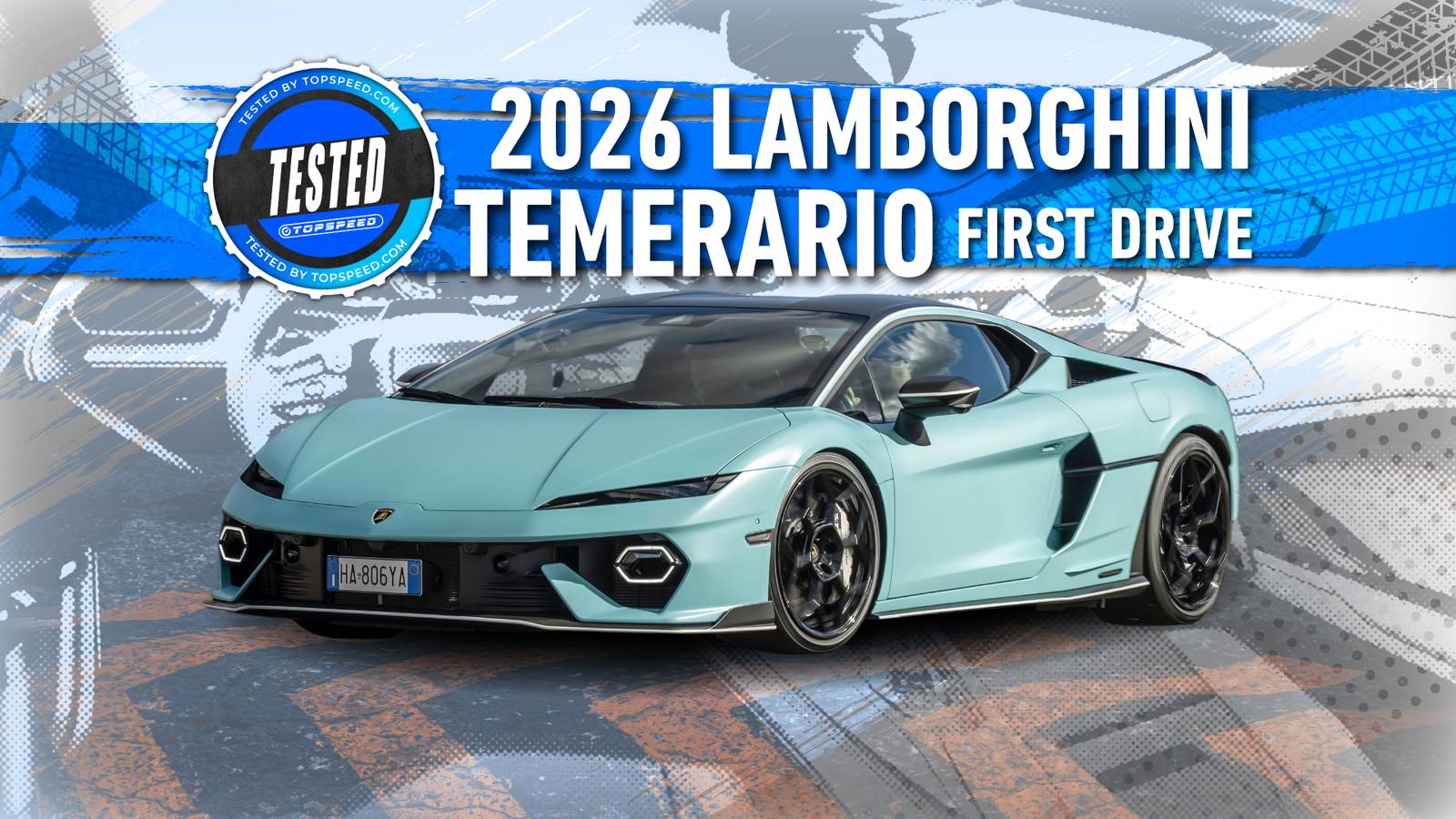
Unlike the almost organically shaped Huracán, the Temerario is far more aggressively styled, wearing its sophisticated aerodynamic design right on its sleeve. Up front, for example, the narrow headlights live behind a pair of tiny winglets integrated in the bumper, scooping up air from the front and channeling it around the car seamlessly. Two illuminated, open-element hexagons serve as both brake ducts and fog lamps, and they float ethereally in the front corner air intakes. The shape and function of those lighting elements picks up on the rear, where the taillights actually help expel air from the back and reduce trailing turbulence.
The view from behind is also the Temerario’s most exciting. In addition to those modern-looking taillamps, there’s a narrow rear diffuser and a cutaway bumper that puts the car’s fat, 325-millimeter-wide tires on full display, a look that the company says is inspired by its corporate cousin Ducati. As seductive as they look, don’t follow a Tem too closely, or you’ll get a face full of gravel and rocks – perhaps the design choice will also discourage tailgaters.
Although the Temerario is a mostly modern design, there are a handful of heritage-inspired design cues. A kinked, vertical side intake feeds fresh oxygen to the hot-vee eight-cylinder in the middle with a shape that ever-so-slightly apes the Gallardo. Nineties kids will love the Diablo-lookin’ ducts on top of the rear fenders, although their shape is less NACA and more Tron. And like any good modern Lambo, the Temerario’s trunklid has inward-canted sculpting that recalls the Countach’s geometric front end. Although the design isn’t as cohesive as the Huracán’s, the latest Lambo is still an appealing piece of machinery.
Driving Impressions And Performance
Life On The Bleeding Edge
Like most plug-in hybrids, the Temerario defaults on start-up to its electric-only Citta drive mode, allowing you to slip out of the neighborhood without coming home to a noise complaint from your HOA. But actuate the rather confusing array of mode switches on the steering wheel and you’ll uncork the full potential of the powertrain, which comprises the aforementioned 4.0-liter flat-plane V-8, augmented by two turbochargers to produce 789 horsepower and 538 pound-feet. Even on pure combustion power, the Temerario still outranks the hardcore Huracán STO, which makes 631 hp and 417 lb-ft.
And since too much isn’t enough when it comes to a Lamborghini, there’s also a 3.6-kilowatt-hour battery pack between the seats, which sends power to three axial-flux electric motors – one on each front wheel and one in between the engine and the rear-mounted eight-speed dual-clutch transmission, similar to the Revuelto. Get everything warmed up appropriately and the Temerario produces a pavement-shattering 907 hp, with up to 590 lb-ft on hand with launch control activated.
2026 Lamborghini Temerario Technical Specifications
|
Engine |
Twin-turbocharged 4.0-Liter V-8 PHEV |
|
Battery Capacity |
3.6 kWh |
|
Electric Motor Type |
3x YASA Axial-Flux |
|
Transmission |
Eight-Speed Dual Clutch |
|
Driveline |
AWD |
|
Horsepower |
907 HP |
|
Torque |
538 LB-FT (590 LB-FT w/ Launch Control) |
|
0-62 MPH |
2.7 Seconds |
|
Top Speed |
213 MPH |
The only number that should matter to driving enthusiasts, however, is the 10,000-rpm redline. You’ve got to rewire your brain if you want to achieve those lofty revs, because the engine hits such a thrilling song at 8,000 rpm that it seems only natural to upshift. But do so and you’ll deprive yourself of the predatory shriek that appears as the tach sweeps to its upper reaches. It’s a sound that’s more akin to a lynx or a panther than a car, meaning the tingles I felt running up and down my spine must have been some kind of primordial fight-or-flight response.
Find an appropriately straight stretch of road and the Temerario lunges into the distance. Lamborghini thinks it’ll hit 62 miles per hour in 2.7 seconds; I think they’re nuts. This car has to be flirting with the low 2s by my butt dyno’s measurements, although I will admit that its calibration may have been thrown off by the noise emanating mere inches away from my ears. A top speed of 213 mph is probably theoretical for most buyers, but it does exceed the Ferrari 296 Speciale by eight ticks on the dial.
The Lamborghini also attacks corners with unbelievable tenacity, the quick steering seemingly reading your mind before your hands even get the message. Communication through the wheel is also pleasantly direct, with the rest of the chassis transmitting messages directly to your tailbone and shoulder blades. Predictably for such a wide, low vehicle, body control is fantastic, yet there’s still enough wheel travel to make quick work of bumpy roads. If you manage to run out of grip in dry conditions, you’ve got no one to blame but yourself, since the brand-specific Bridgestone Potenza Sport tires are stickier than improperly proofed foccacia dough.
The Tem is so ferocious that some drivers – myself included – will need to get used to the immediacy of the controls. Thanks to the proliferation of traction, launch, and stability controls in most modern cars, full-throttle acceleration is usually a zero-drama affair. But the little Lambo is more than happy to squirm around a bit when you punch it, even resorting to some minor (and easily controllable) torque steer up front. The logical solution is to get the tires nice and warm before you push it too hard, but for the uninitiated, the Temerario does a delightfully frightening impersonation of the hairy, lairy Lambos of old.
2026 Lamborghini Temerario Plug-In Hybrid System
Don’t presume the PHEV componentry in the Temerario is there to make it an eco-weenie. The electric motors may reduce emissions a bit, but the paltry EV-only range of about 5 miles makes it clear that the axial-flux units are there primarily for performance. And perform they do, borrowing much of the powertrain control logic from the larger, V-12-powered Revuelto.
In addition to providing added thrust when you push down on the skinny pedal, the front electric motors also assist with torque vectoring in tight corners, both by adding propulsion to the outside wheel and giving some regen drag to the inside – a move that helps keep the battery charged in high-performance driving.
Ditto the rear motor’s clever traction assistance. If the driver calls up too much throttle for the conditions, the transmission-mounted motor will apply some resistance, interrupting power transfer to the wheels without mandating a herky-jerky throttle cut or overcooking the brakes.
And the handoff between internal combustion and electric propulsion is remarkably seamless. Throttle response is brisk thanks to the traction motors’ instant torque, which gives the turbochargers enough time to spool up before the V-8 takes over primary thrust duties. And despite the preternatural quickness of the dual-clutch transmission, the motors step in ever-so-briefly to ensure even smoother shifts and reduced loss of momentum. It’s frankly incredible that Lamborghini could take such complicated machinery and make it feel so natural.
Interior Design And Comfort
The Word “Cockpit” Has Never Been So Apt
Remember that scene in Independence Day where they boot up the alien fighter ship and fly it for the first time? That’s what climbing aboard the 2026 Lamborghini Temerario feels like. That’s because, despite a high-tech appearance thanks to the protruding, vertically oriented touchscreen and wing-shaped dash design, it’s rather easy to get comfortable and acquainted with the newest Lambo in just a few minutes. The cabin is much more spacious than the Huracán’s, with 1.3 inches of additional headroom and 1.8 inches of added legroom, and most of the controls are in a logical position. There’s even some very welcome drama, with the start button hidden beneath a nuclear-launch button cover.
That said, you’d better sit in both the standard “comfort” seats before you order your Temerario. Although supportive and well-padded below the ribcage, the chairs narrow into a flat ironing board around your shoulders, which isn’t only annoying in corners, it’s downright uncomfortable on long drives. Paradoxically, the thinner padding and more aggressive bolsters of the optional sport seats are better in almost all driving situations.
That includes high-speed grand touring, which the Temerario will probably be pretty decent at thanks to a deep front storage well that measures just under 4.0 cubic feet – big enough for two roll-aboard suitcases or a few duffel bags. There’s also a handy parcel shelf aft of the seats, which provides a little more storage for soft, squishy cargo.
Human-Lambo Interface
The Temerario takes after its Revuelto big sibling in terms of technology, with a vertical 8.4-inch touchscreen that floats above the center console. A 12.3-inch digital instrument cluster offers a handful of display layouts and plenty of information on vehicle systems, including temperature readouts for the transmission, oil, coolant, tires, and brakes. The software is also decently easy to navigate, although there are a few too many menu choices in the touchscreen for quick operation.
The cabin is refreshingly simple when it comes to electronics, with the only pixelated overkill showing up in the 9.1-inch passenger display. It’s too slim to serve any useful copiloting function, like adding navigation destinations or adjusting the audio system. All it really does, then, is tattle on the driver thanks to the always-on speed readout.
An Early Pick For All-Star Status
Although time will tell if the Temerario achieves the same devoted following as the Huracán – enthusiasts really love that V-10 engine – I think that Lamborghini’s newest baby supercar is the equal or superlative of its predecessor in almost every way. That unfortunately includes price, because the Tem will start at $386,649 with destination, an increase of more than $100,000 compared to the entry-level Huracán.
But then again, the 2026 Lamborghini Temerario combines many of its predecessor’s best attributes, like nimble handling and aggressive proportions, while infusing in some historic histrionics that might have been missing from the Audi-influenced V-10 supercars of old. Between the flagrant 10,000-rpm redline and the almost twitchy steering and power delivery, the Temerario isn’t just a great followup to the Huracán, it’s a throwback to when Lamborghinis wanted to please you and kill you in equal measure. Approach it with respect and you’ll have an absolute blast.
Read the full article here