


It’s been more than a decade since automakers worldwide have identified the annual Consumer Electronics Show in Las Vegas as the ideal place to share their latest digital feats — and even new production vehicles — and to rub elbows with tech bros.
Ford is there this year, sharing more information about its Universal EV Platform that is designed to underpin a series of affordable battery-electric vehicles, including a midsize electric pickup starting in 2027.
Tech ‘Must Be Attainable’
We’ll have to wait longer for Ford to fill in the blanks with actual vehicle details, but this week in Vegas the focus is on artificial intelligence, an “unparalleled customer experience” and the overriding message that new technology doesn’t mean much when it’s only available on vehicles priced above $70,000.
“Truly impactful technology must be attainable,” says Doug Field, Ford’s chief EV, digital, and design officer, who is at CES with his team to share Dearborn’s latest AI developments. “If it doesn’t reach the many, it isn’t a revolution — it’s a luxury.”
Looking Beyond Bluetooth
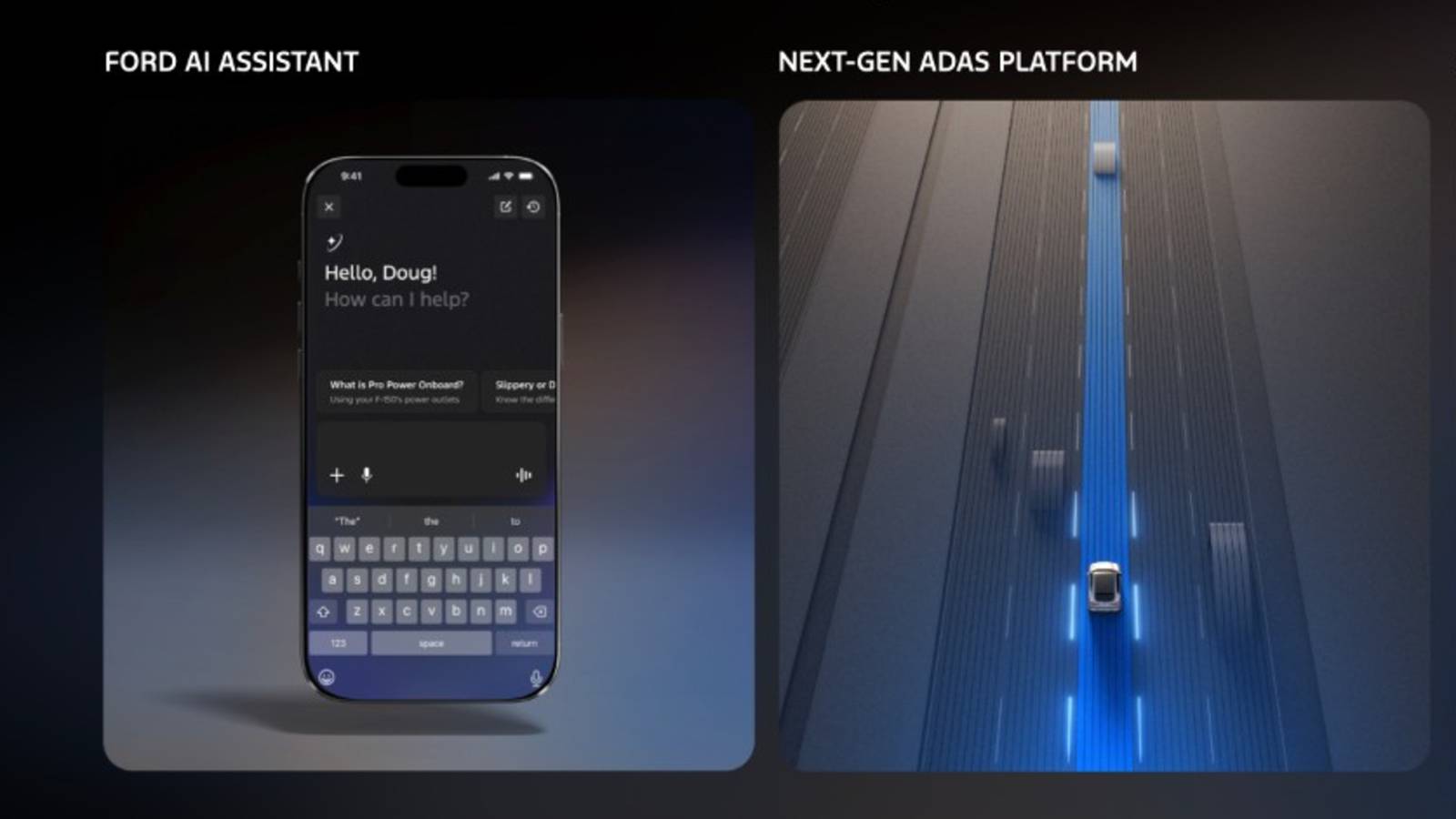
Ford says its new AI Assistant relies on a “seamless” link between the vehicle and your smartphone. Sure, we all have Bluetooth connections between our phones and modern cars to safely manage calls, hands-free texting, real-time navigation and streaming audio, but Ford is convinced that customers want to do much more.
“What customers need is intelligence that understands where you are, what you’re doing, and what your vehicle is capable of, and then makes the next decision simpler,” Field says.
How Much Mulch To Haul
For instance, you own an F-150, and your phone knows the specific size of your bed. You need lots of mulch for the garden, and you’re wandering the yard at Lowe’s trying to calculate how many bags of mulch on that pallet will fit in the bed.
Using your Ford app on your phone, you take a picture of the pallet of mulch, and AI will tell you how many bags will fit. If you’re a luxury customer, you should also be able to use your Lincoln app in the same way to see how many bags will fit in the cargo hold of your Navigator. But use a tarp, lest you sully the Black Label interior.
This technology rolls out early this year and is projected to reach up to 8 million Ford and Lincoln customers.
More Hands-Free BlueCruise
But wait, there’s more. Ford says that by designing its own software and hardware in-house rather than outsourcing it, Ford is hinting that hands-free driving via BlueCruise will be coming to more vehicles, “not just vehicles with unattainable price points,” Field says.
There’s no specific announcement about a BlueCruise price cut at this time. In October 2024, Ford dropped the BlueCruise price to $2,495 as a one-time purchase option, or subscribing for $49.99 a month or $495 a year after a 90-day trial. Some 1.2 million Ford vehicles are already on the road with BlueCruise.
Watch For Tech In 2027
Ford says it owns the technology that drives its driver-assistance systems in the latest vehicles, a strategy that adds “significantly more capability” while cutting costs by 30 percent. These internal efforts are expected to bear fruit in 2027 as this new hardware and software are deployed in vehicles from the Universal EV platform.
The following year, Ford promises Level 3 “eyes-off driving” will be road ready, rolling closer to an autonomous future with an advanced “vehicle brain” that unites infotainment, driver assistance, audio and networking.
Source: Ford
Read the full article here