




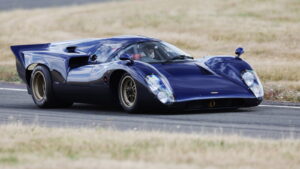



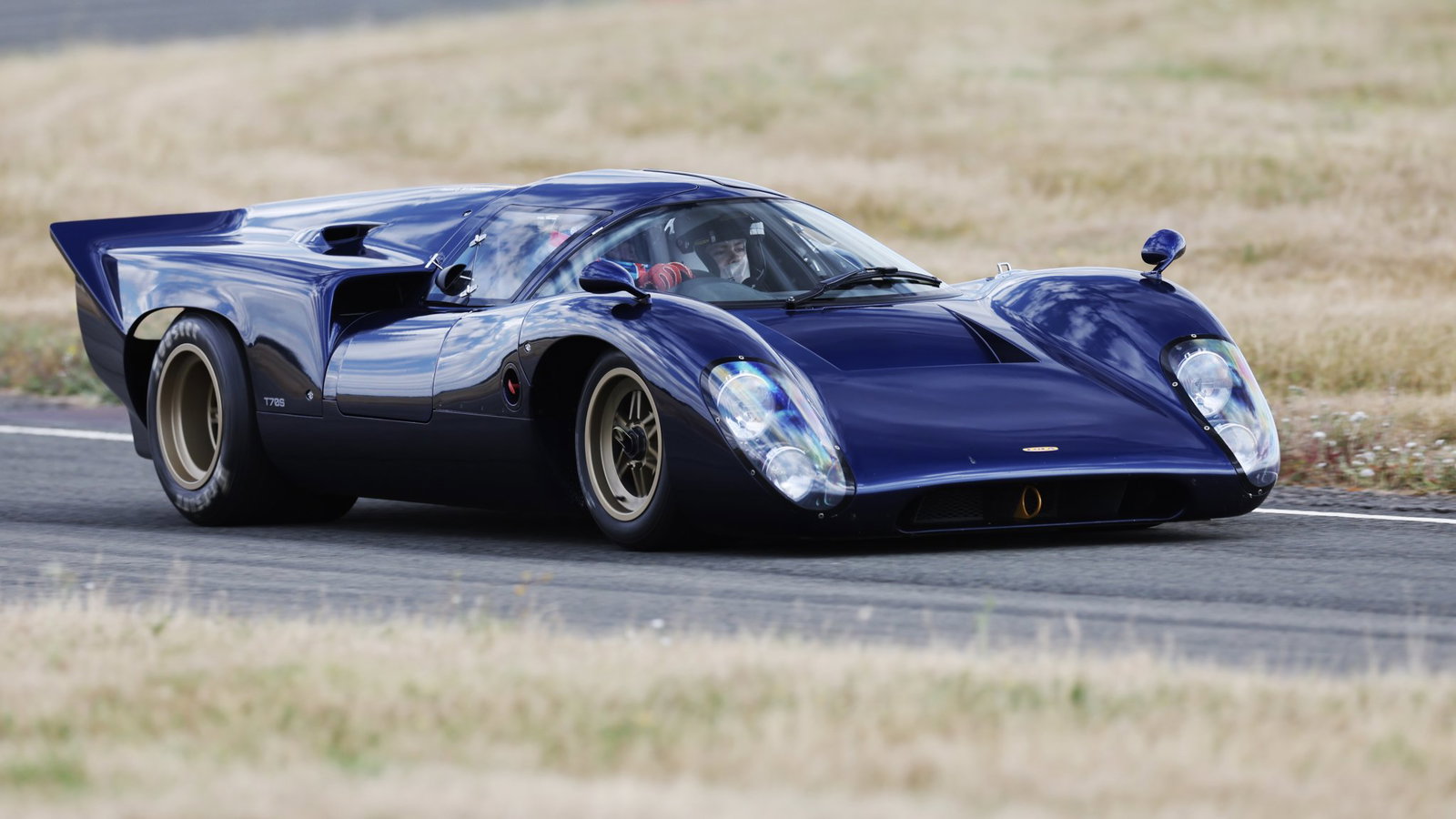
The first thing I notice when the whine of the Lola T70S’s starter motor is replaced by the bark of its 5.0-litre, race-built small-block Chevrolet V8 is that it’s a bit… quiet. It’s louder than the average road car, sure, but standing a few feet from an inch-perfect recreation of a late ’60s Can-Am racer at idle should be shaking the ground and turning my bones to dust, and it just isn’t.
This, in all fairness, is very much not Lola’s fault. We’re at the MIRA test track in Warwickshire, where strict noise limits are in force. Fine if you’re testing an upcoming EV, less so if you’re running what is, for all intents and purposes, a racing car that hails from a time when you’d have been laughed out of the paddock for suggesting racetrack noise limits. So Lola has had to muffle the car, and hence it’s possible to hold a conversation in its general vicinity.
Lola T70S – rear, static
This, of course, isn’t actually a car from the late 1960s. It looks like one, and it’s built to the exact specifications of one, but it’s brand new, first revealed back in the spring by a reincarnated Lola, once a leading name in sports car racing. The original T70 was the company’s most successful, famous racing car, so though the company’s comeback was rather unexpectedly spearheaded by a Formula E entry, this is something more akin to what it’s best known for.
16 will be built, split however demand dictates between a track-only racing version and a road car, which will get a few more nods to modern usability and be powered by a different, emissions-compliant 6.2-litre Chevy V8. This prototype, though, is the racer, and it’s so faithful to the original that it gets a full FIA Historic Technical Passport, meaning it’s eligible to race alongside bona fide historic cars.


Lola T70S – detail
That’s despite an ultra-modern construction that emphasises sustainability. The body panels are made from a new, patent-pending material called Lola Natural Composite System (LNCS) constructed from flax fibre and volcanic basalt rock. The magnesium in the wheels is sourced using an utterly baffling process that involves extracting it from seawater, and this prototype is running on Sustain biofuel. Lola wants to prove that a thundering V8 racing car can still tread lightly on the planet.
Back to MIRA. To handle the T70S’s testing, Lola has enlisted Johnny Herbert, three-time F1 race winner and once a teammate to Michael Schumacher at Bennetton. Now 62 and retired from professional racing, Herbert appears to have lost none of his racing driver instincts, as he proves while I watch him thrashing the T70S around MIRA’s handling circuit, snatching big handfuls of opposite lock and having a couple of big, smoky lockups.

Johnny Herbert
It’s soon time for my turn in the car. Not as a driver, obviously, but sitting alongside Herbert. And I really mean alongside. The T70S’s passenger seat, in racing guise, isn’t exactly meant for regular use, and while the 1.67m tall Herbert has the frame of an F1 driver, I very much don’t. Some painful contortions and awkward, occasionally intimate fumbling with the five-point harness later, I’m in, my right arm awkwardly raised up to give Herbert’s left somewhere – anywhere – to go.
The whirr of the starter motor, then the yelp of the engine firing into life. It’s still not deafening in here, but the way the entire car rocks and thrums with the vibrations of the engine is just so ’60s racing car. It’s clear that, were you somewhere with less stringent noise limits, this would be an earplugs job.

Johnny Herbert and the author in the Lola T70S
There’s a graunching metallic clank as Herbert heaves the meaty five-speed Hewland gearbox into first, and as we kangaroo out of the paddock, the whine of those straight-cut gears competes with the V8 for aural bragging rights. So far, so old school.
But then we get out onto the circuit, Herbert mashes the right pedal, and the performance is anything but old school. Lola gives the engine’s power as 530bhp, and the car’s dry weight as 860kg. Even with two people and fluids on board, we’re likely only just hovering above a tonne, which makes Lola’s quoted 2.5-second 0-62mph time feel every bit believable. Certainly, the first of two tight right-handers that link together this relatively simple course fills the tiny curved windscreen alarmingly quickly, especially as Herbert is on the big four-piston at the last possible moment. You can take the racing driver out of the race, etc.
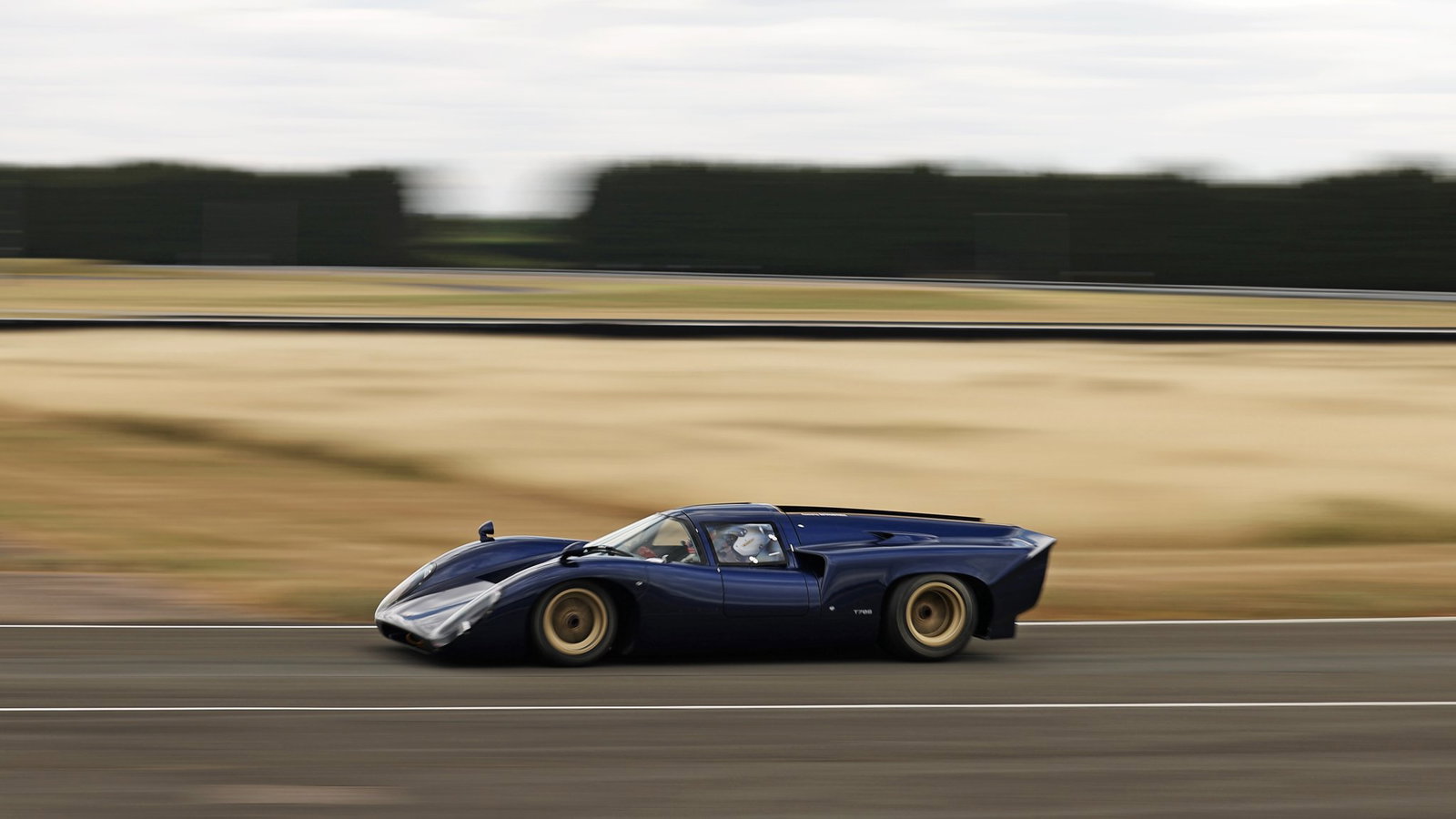
Lola T70S – side, driving
Truthfully, a passenger ride like this is never going to provide a true picture of what a car’s like to drive, but it’s plain to see that Johnny’s enjoying himself, and that the T70S is doing largely what he wants it to, when he wants it. It’s certainly not without its physicality, though, as is proven when Johnny correcting a slide with a handful of opposite lock causes him to sharply elbow me in the kidney.
Here’s what I can report, based on this quick passenger seat blast. The T70S feels every bit as savagely fast as you’d expect a sub-tonne, 530bhp racing car to feel, and that, true to its Can-Am road racing roots, it’s clear that it corners with a real keenness and agility. What’s also evident is that it’s not been watered down even slightly: the brakes will lock up, the back end will break loose, and it will punish the unwary and the overzealous.
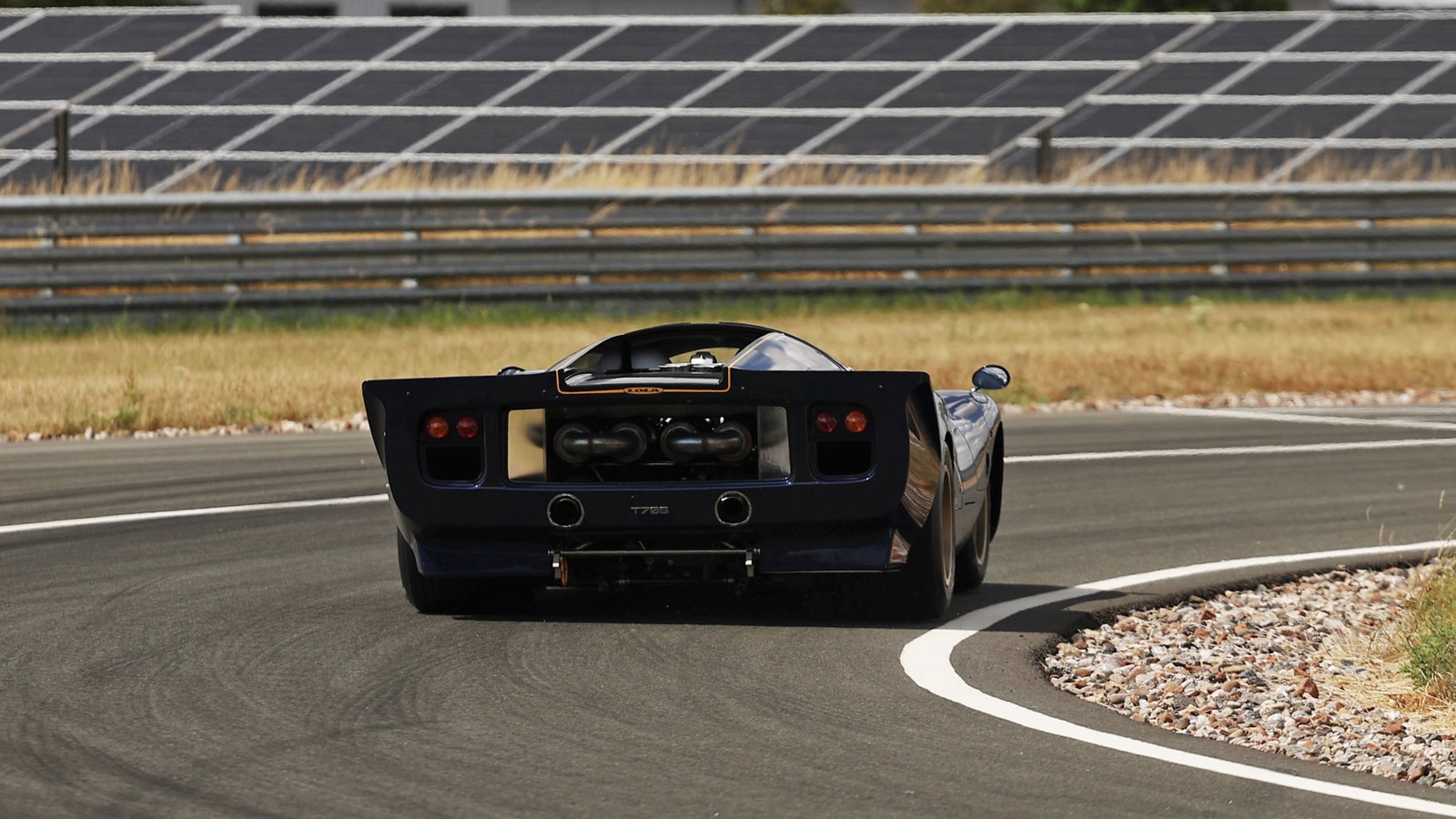
Lola T70S – rear, driving
Lola hasn’t given a price for the T70S racer yet, but expect it to be somewhere in the high six figures at the very least. Despite that, this isn’t just a millionaire’s plaything: it’s a proper, unfiltered racing machine, and one that will require the appropriate level of skill to get the best out of. This, presumably, was key to it getting its FIA historic accreditation. Could it have had driver assists and a semi-automatic gearbox? Perhaps, but that would have missed the point.
Anyway, that’s what the road version is for. Sort of. Called the T70S GT, it’ll have a few extra nods to usability like air-con, some luggage space and slightly more padded seats, but we’re still promised it’ll be a largely uncompromising experience. Testing of it will begin later this year.
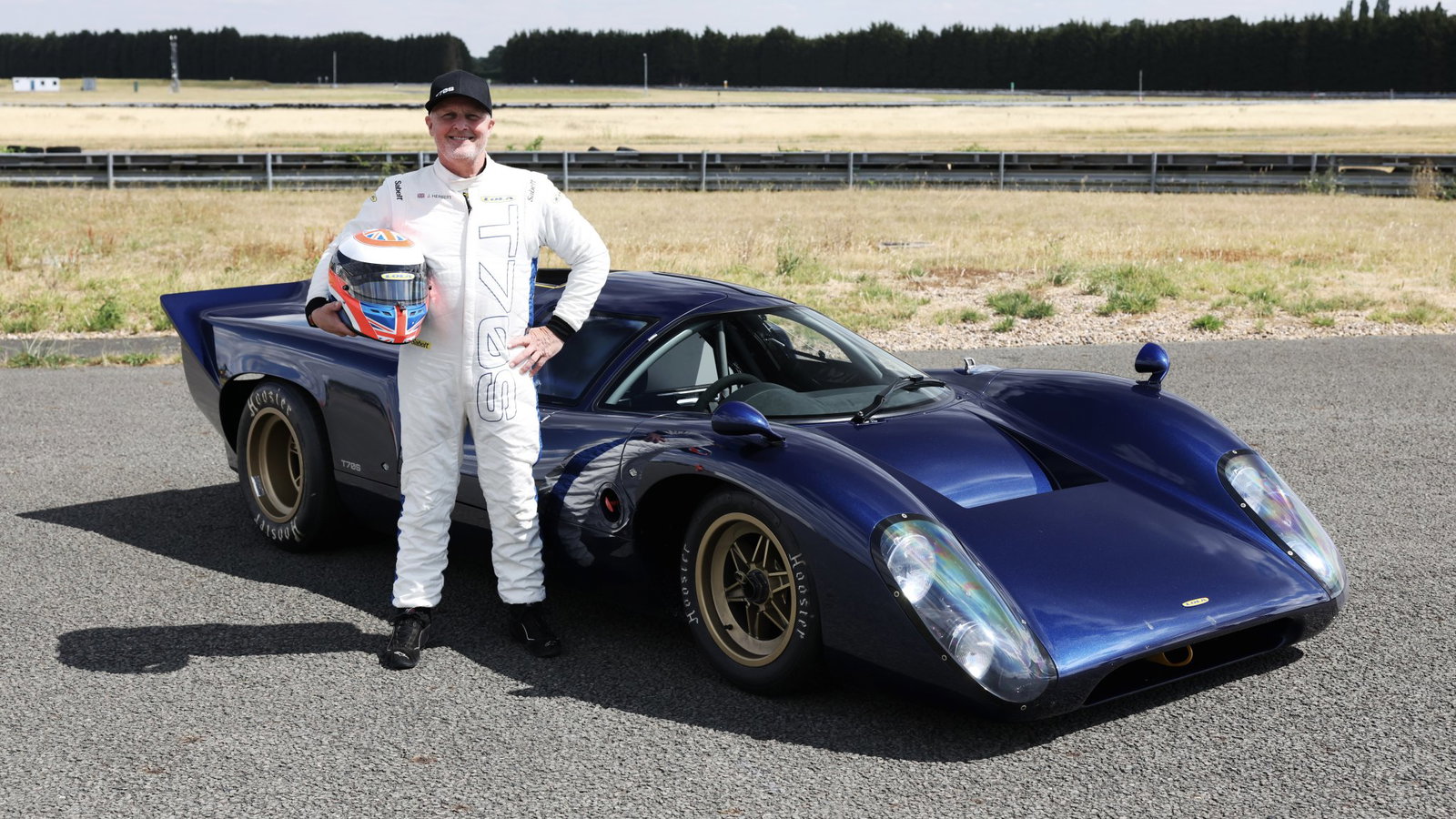
Johnny Herbert with the Lola T70S
Perhaps the most fascinating part of this whole project, though, is the sustainability aspect. Arguably, a tiny-volume sports-stroke-racing car only likely to be used sparingly throughout the year isn’t the first place the car industry needs to be looking at knocking down its CO2 output, but all this tech has to get started somewhere. Matt Faulks, Lola’s executive innovation director, says the company is already in talks with several others about using LNCS, although it’s not quite ready to talk about who yet.
If it can truly scale up some of the eco-friendly innovations at play here, though, then the car industry of the future might be able to benefit from a project very much rooted in a celebration of the past. Now, we just need to have a listen to it somewhere with less strict noise limits…
All images: Lola Cars/Jakob Ebrey
Read the full article here


