


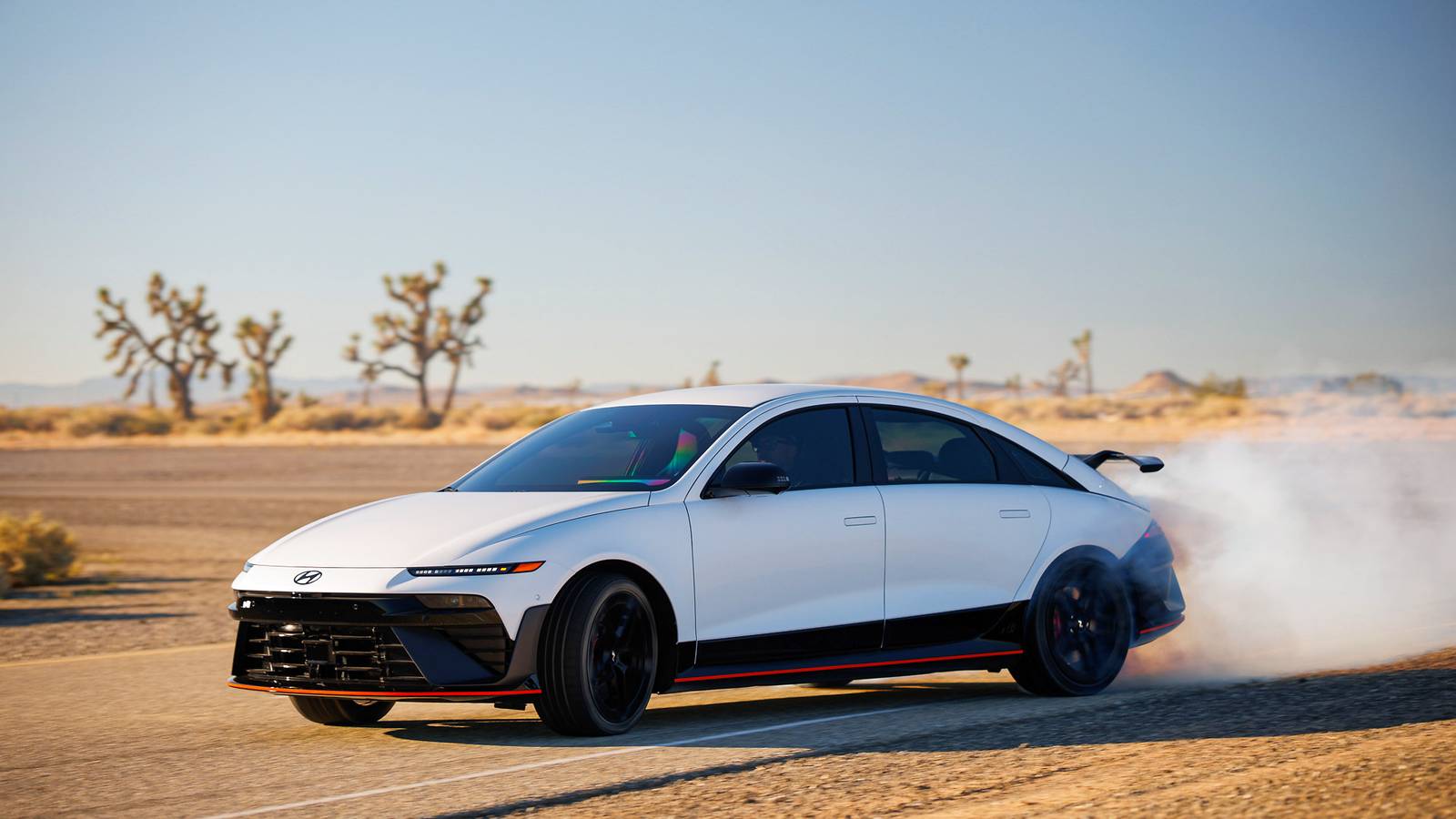
Hyundai just gave the Ioniq 6 the same hot-rod treatment they’ve already given to the Ioniq 5 N. This includes simulated gear shifting, a launch mode, and the ability to unlock 641 horsepower for 10-second sprint sessions. Standard horsepower is hardly weak sauce. The all-wheel-drive, 84.0 kilowatt-hour (kWh) powertrain spec is identical to that of the Ioniq 5 N, and like that car, belts forth 601 horsepower and 568 pound-feet of torque. A top speed of 160 MPH is also pretty impressive.
But Hyundai went further still, adding a bunch of mechanical goodies that should make this latest Hyundai N model pretty competitive against hotter Ford Mustangs and a few gas-driven BMWs we can think of.
For starters, Hyundai engineers made sure that they reinforced the Ioniq 6’s chassis. They used additional welds and adhesives, and they added a stiffer rear anti-roll bar and other underbody reinforcements. This was all to increase cornering precision and reduce vibration. Engineers also added an electronic limited-slip differential (e-LSD), for quicker power engagement, and reinforced axle stiffness, to quicken steering response.
Adaptive Suspension—Plus Lots More
To make the Ioniq 6 N a track machine that wouldn’t ride harshly, Hyundai went further still, revising some suspension geometry and adding stronger bushings, to hasten high-speed chassis response. Also, Hyundai includes stroke-sensing, electronically controlled adaptive dampers. The driver can lower the suspension for sportier driving, and Hyundai’s new programming doesn’t stint on how the brakes feel, either. Regenerative brakes could deaden response on the track, so Hyundai recalibrated the Ioniq 6 N’s stoppers for separate performance vs. daily driving regeneration.
Slippery And Wider
Hyundai developed a swan-neck rear wing to improve downforce, but the shape of the wing doesn’t create too much drag—which could harm the Ioniq 6 N’s range. Already, we expect that will be less than the 270 miles the Ioniq 6 achieves with AWD and 20-inch wheels. The 6 N gets 20s as well, but stickier, Pirelli P-Zero 5 tires. Plus, the fenders are flared. It looks menacing for sure, but these enhancements likely create a little more drag.
A Unique Transmission Experience
As with the Ioniq 5 N, Hyundai has programmed what feels like shift points in the single-gear transmission of the Ioniq 6 N. Hyundai calls this “N e-Shift,” and the system simulates paddle-shifting of a manumatic gearbox, and also simulates audible feedback through the car’s sound system. Having driven the Ioniq 5 N, we can tell you that it eerily does seem like you’re “shifting” an actual transmission.
Drifting For Days
Hyundai layers in several “N” modes for this transmission, too, including launch capability from the N Grin Boost mode, which maximizes acceleration, plus customizable drift capability, for instance, sending more power through the rear tires. There are up to 11 levels of torque split that are driver adjustable, which is something that would be impossible with a gas-powered car. If you’re a track or drift nerd, we think you’re going to be pretty interested in this Hyundai.
Track And Street Cleverness
Hyundai is enabling a customized system that allows the car to “know” the track you want to race. While we don’t know all the details, this enables a “ghost” car with target times to keep pace with. The idea is that you’d have track-in and -out apexes and speed targets, and be able to see real-time pacing as you’re driving. Also, Hyundai’s using the interior LEDs as a “shift” light, meaning that it’s not just on the speedometer, like on a gas car, but the entire cabin glows as you climb simulated RPM, and that intensity increases toward “redline” … again, all to emulate driving a machine that runs on dinosaur bones.
TopSpeed’s Take
An Ioniq 5 N will set you back nearly 70 grand. There are a lot of sports cars you might buy instead. And we’d bet the 6 N is running to the same price strata—prices were not announced by the carmaker. Hyundai’s already said they’re not making thousands of these cars, and that’s not surprising. This is a very specific machine for a very specific kind of buyer. Still, it’s great that Hyundai is pushing boundaries, and we think that carmakers giving chase—Hey there, Toyota?—are likely going to explore the extremes of electric sports cars, too. They have to. There’s too much versatility and so much instant horsepower. What’s not to like about that?
Read the full article here