


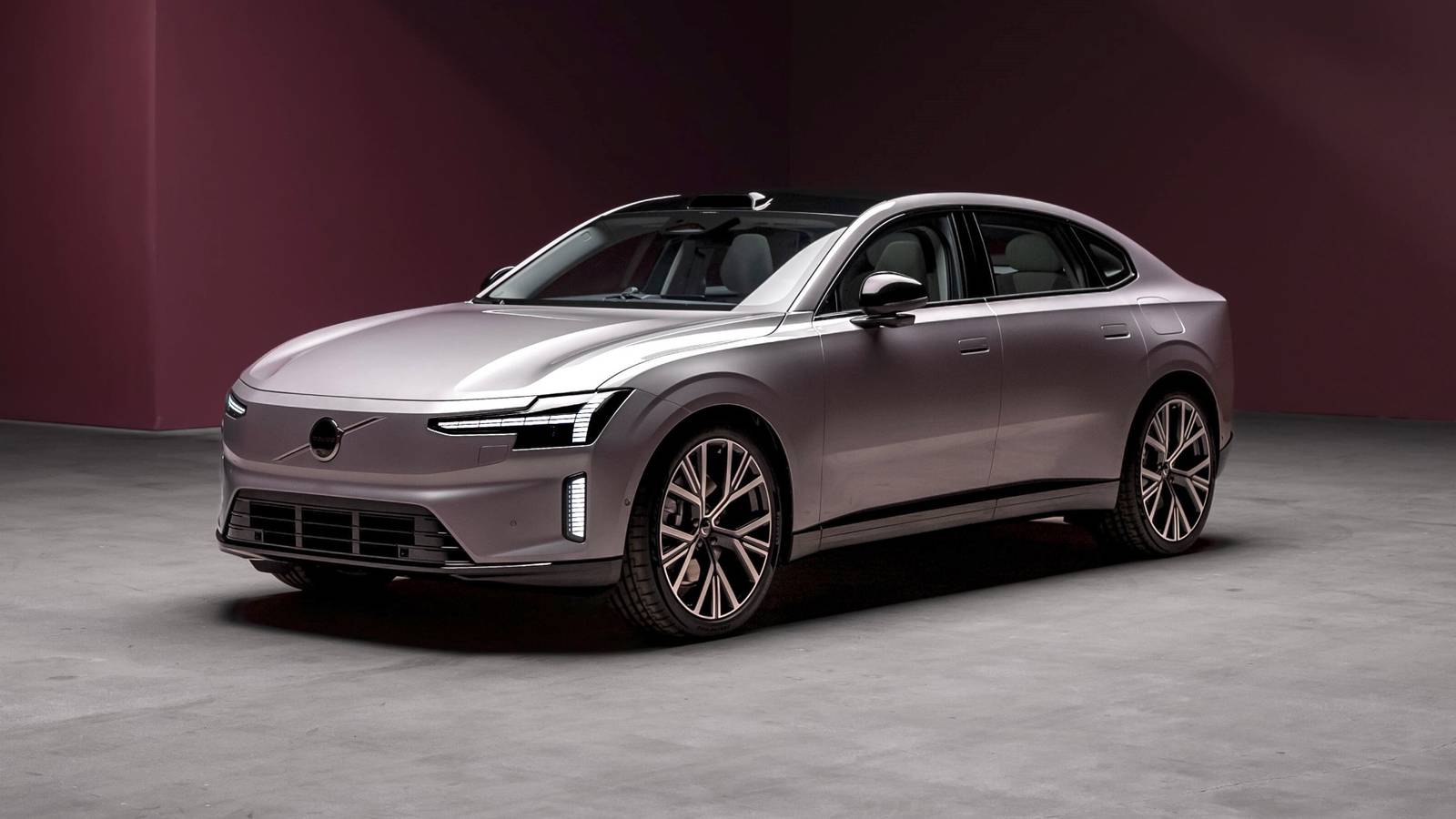
The future of Volvo is the future of every European carmaker in the U.S. While Volvo, Mercedes-Benz, BMW, Audi, and Volkswagen have all committed to electrification, they’re all beginning to see that EV adoption is slowing everywhere but China. However, industry watchers say that Chinese manipulation of the market is likely to lead to that bubble popping.
Meanwhile, Volvo’s strategy in the U.S. will see us gaining models made specifically for our meh charging infrastructure and—relative to the rest of the world, save the Middle East—dirt cheap gas. This means we’ll get a very specific new kind of hybrid from Volvo—and, likely, from their European peers, too. But how exactly is Volvo going to pull this off? And what about these rivals?
The XC60 and EX60
Volvo currently sells the XC60 PHEV. In the future they’ll develop a “second-generation” XC60, which likely means a more advanced PHEV at the very least, with a longer battery-only range. It also seems very likely, because of what peers like Mercedes-Benz are doing with their new CLA and forthcoming GLB, that Volvo will consolidate how it makes its cars “modular,” with platforms that can be more readily altered from market to market and from powertrain to powertrain. In the near term, Volvo will move production of the XC60 to its South Carolina facility, which already makes the larger EX90 EV and the Polestar 3.
EX60 for U.S. Buyers
The EX60 is the next new Volvo, set to be unveiled in January and on sale later next year. It will sit on a megacast platform, where a more energy dense battery is used within the chassis as a single component, replacing a far more complex array of parts. The seats can literally be attached to the megacast underbody. Volvo is ahead of carmakers like Ford, which says they have to shift to megacasting as well.
The upside to megacasting is that it radically reduces the cost of making cars—and greatly reduces weight. Volvo says the EX60 will cost about the same as the XC60 PHEV—addressing a major barrier to EV entry right now, which is sticker shock. The EX60, for now, will be made in the EU. However, that means absorbing 15-percent tariffs—or passing them on to customers by spreading that pain more broadly.
Maybe An EREV Is Coming
During their third-quarter earnings call, Volvo talked about developing an XC70 specifically for the Chinese market, which debuted a few months ago. This is an electric car with a gas-motor backup. It’s what the industry calls an EREV, and the idea is that you get EV range, but for longer trips, don’t have the time-consuming hassle of publicly charging. EREVs will be popular in the U.S., because they also enable towing without range worries, or the pain-point of trying to dock at a charging station with a boat or trailer hooked up.
Why All Carmakers Will Need EREVs
The current XC70 for China has a whopping 745 miles of total range and about 120 miles of EV-only range. But Volvo said they’re likely to develop a version for sale in Europe, too. And that probably means more EV range—and in turn, we’d guess this also means that such an XC70 would fit well with what American consumers want. In their earnings call, Volvo executives talked about buyers who are not quite ready for an EV—but close. If that buyer can get an EREV instead of a full EV—at the same cost of the forthcoming XC60—they’ll basically become a default EV customer who mostly plugs in at home and gets all their around-town driving done electrically.
Survey Says?
The need for carmakers to have a slow-but-steady ladder to EVs is backed up by recent research from both J.D. Power and Boston Consulting Group, which suggests that EV interest is relatively sturdy—despite subsidies drying up in both the U.S. and the EU, and that younger buyers will bite on full EVs once they hit cost parity. But hangups about charging headaches and range are also durable. For this reason, Volvo is working on an entirely new range of plug-in cars, and our bet is that it will include at least one EREV for the U.S., since they’ve already developed one for China.
“These cars will be like a BEV, they will drive like a BEV, they will have the infotainment like a BEV, and they will feel like a BEV. But you have a backup engine for customers who are living in an area, which is not ready yet for this infrastructure and they cannot charge, or for customers who doesn’t want a BEV yet.”—Michael Fleiss, Volvo Product Strategy
Computer As Car
Volvo says its forthcoming EVs—and hybrids—will be what the industry calls “software defined.” Essentially, all carmakers are going in this direction, though EVs have been leading this charge. The idea is to have an integrated, combined software and hardware stack. Brands like Ford have already argued that they need to make cars this way. Rivian will provide that “back-end” tech to the Volkswagen Group, and newly reborn marques like Scout will make SDVs. Mercedes is already headed that way with MB.OS running all tech within their new CLA, but Volvo is in the mix as well, announcing that they use this tech on the EX60 and on forthcoming hybrids. That later part is a big deal; it means that regardless of powertrain, a car can receive over-the-air tech upgrades, which in part eliminates annoyances like heading to the dealer for a recall that’s merely a software patch.
TopSpeed’s Take
Volvo is a relatively small carmaker with an outsize footprint. That’s in part thanks to their heritage, and thanks to an early partnership with China’s Geely. Where brands like Ford seemed taken aback by China’s EV lead, Volvo was there early, and so the carmaker’s battery and tech evolution have been in their DNA more deeply.
But a carmaker as large as Ford or a Volkswagen, or a medium-sized one like Mercedes-Benz has identical pain to deal with around tariffs, since they’re all global. Volvo’s localized production and model strategy is one response, and likely Volkswagen and Audi, as well as Mercedes, are going to have to expand North American production. But they’re also likely to need EREVs for the U.S., and to have flexible architectures that can accommodate EREV, plug-in hybrid, and conventional hybrid powertrains. It’s possible that SDVs and gigacasting are also answers to the extreme costs for consumers. Because the biggest challenge is that car buyers are saying they cannot afford new cars, and any downturn in the global economy will only make that worse.
Sources: J.D. Power and Boston Consulting Group
Read the full article here